"The monk who sold his Ferrari" by Robin Sharma

Book.
Author: Mikhail Bulgakov
Genre: magical realism
Score (1 to 6): 6
Magical Realism. How thematic and magical it sounds, doesn't it. You read the genre and say to yourself, yes, this is what I want my life to be - magic and reality in one. "The Master and Margarita is a huge opus of magical realism - for many readers it's hard, unfair, for others it's funny and light, for others (of which I am one) it's a whole universe.
Bulgakov presents a story in which the Devil himself, under one of his lesser-known names, Voland, comes to visit Moscow. Set before the 1920s, Voland, along with his retinue of creatures - the black cat Begemot, Koroviev, Azazelo (with the demon Azazel as a prototype), Hela and Abadona (the angel of death) - pour into Russia to see how the Soviet system will affect them. The gang commits a handful of "mischief" around Moscow, most of it, far from harmless.
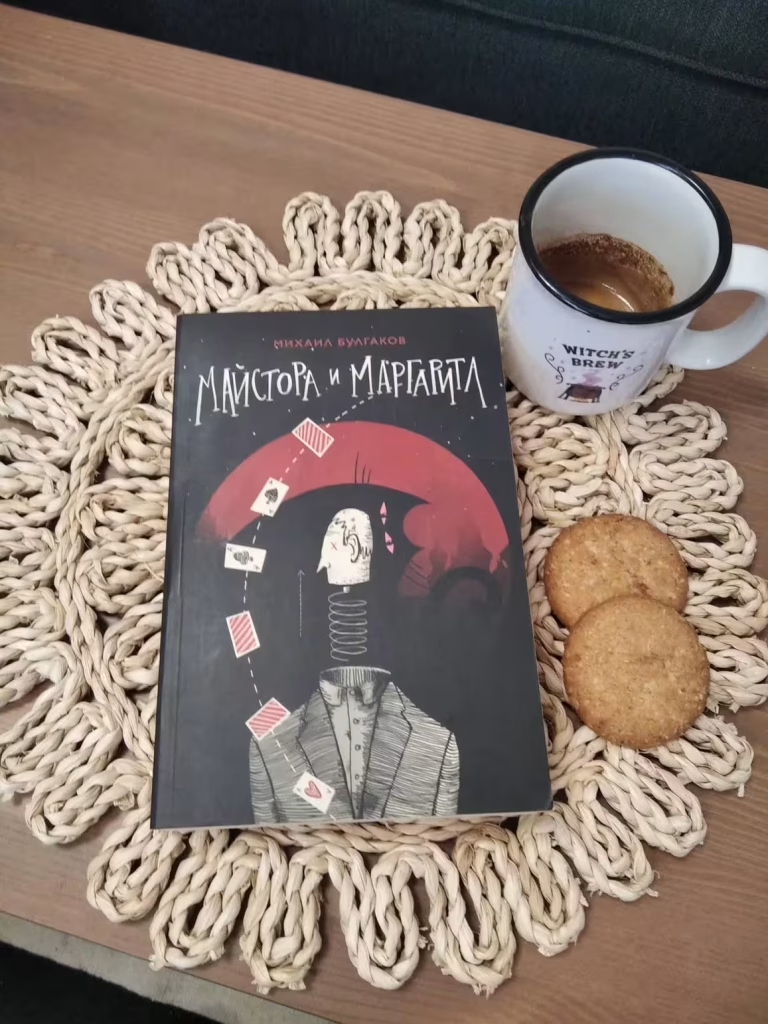
The novel unfolds on two planes (I would even say three). The second is a look at the events is the Gospel. The main actors there are - Pontius Pilate, procurator of Judea and Yeshua Ha-Notzri, miracle worker with a prototype of Jesus Christ. And the situation described is the case surrounding Yeshua's potential crucifixion.
The third plan, which I at least distinguish as a third, actually part of the first - presents the Master himself, a writer put in the madhouse for his novel about Pontius Pilate and tormented by many pains of the soul (Bulgakov himself is often mentioned as a prototype of the Master) and Margarita, a strong female character, beloved of the Master, who discovers her true self by allowing herself unlimited freedom. Eventually hostess at Voland's ball.
Such a complex but ingenious plot. Full of references to various religious and philosophical teachings. "The Master and Margarita is a multi-layered novel within a novel where reality and fiction are blended into one. A lyrical poem in prose, but also a vivid satire of its time.
Bulgakov focuses on global ethical controversies: good and evil, life and death, love itself, creativity, and the moral duty that each succeeding generation sets for itself.
Mikhail Bulgakov was born in 1891 into a middle-class Russian family in Kiev and moved to Moscow in the 21st century. For a time he was a very popular novelist and playwright, but soon his lyrics were banned and he fell into disgrace. The language of his pen is not sharp, analytical and often critical of agendas and social circles. During this period of deep exile and severe emotional state, he wrote The Master and Margarita. He burned the first draft of the novel in his own hand. And the finished novel, after several revisions, was published only after his death. But to this day it is read and respected in many places around the world. And for me he is a social genius on a par with the philosophers of the Twentieth Century.

 English
  Bulgarian
  Spanish