"The monk who sold his Ferrari" by Robin Sharma

Book: 'Thus spake Zarathustra'
Author: Friedrich Nietzsche
Genre:
Score (1 to 6): 4
I'll start from afar, as usual. Philosophy has always been interesting to me, and has been part of my life in one way or another. Since I was a child my grandmother talked about philosophy and psychology and quoted various thinkers to me. At school, on crack, I didn't like the "philosophy cycle", it wasn't interesting to me, I literally didn't listen to anything in class. But at university my passion for the constant search for life's meaning came back and stayed with me.
There are many big names worth talking about. I've already written about some of my favorites - the absolute Simone de Beauvoir, Virginia Woolf, and others - but this time I want to talk about Friedrich Nietzsche. We received a private message request for an opinion on his magnum opus, Thus Spoke Zarathustra, and decided to share a more detailed review of it. We very much enjoy being sought out with specific questions and interests. 😊
I turned to Nietzsche at a particular time in my life, I had fallen into a hole. It was during the pandemic, and the eternal question of what in the universe outside of us here was deeply haunting me. And to this day it hasn't stopped haunting me actually. Then I started reading Nietzsche's advice for a fulfilling human existence described through short stories about the prophet Zarathustra.
Zarathustra was an Iranian religious refomator, founder of Zoroastrianism, once the state religion of Persia. In addition to being problematic for his time because of the split roles of the deities, Zarathustra posed as a central religious issue, the question of morality. And Friedrich Nietzsche was a man who knew, studied, and criticized religious questions in detail. The son of a Lutheran pastor, he grew up with religion. He studied theology and philology, but in the midst of his studies, he rejected religion altogether and eventually became a philosopher. He did so from a place of deep familiarity with it.
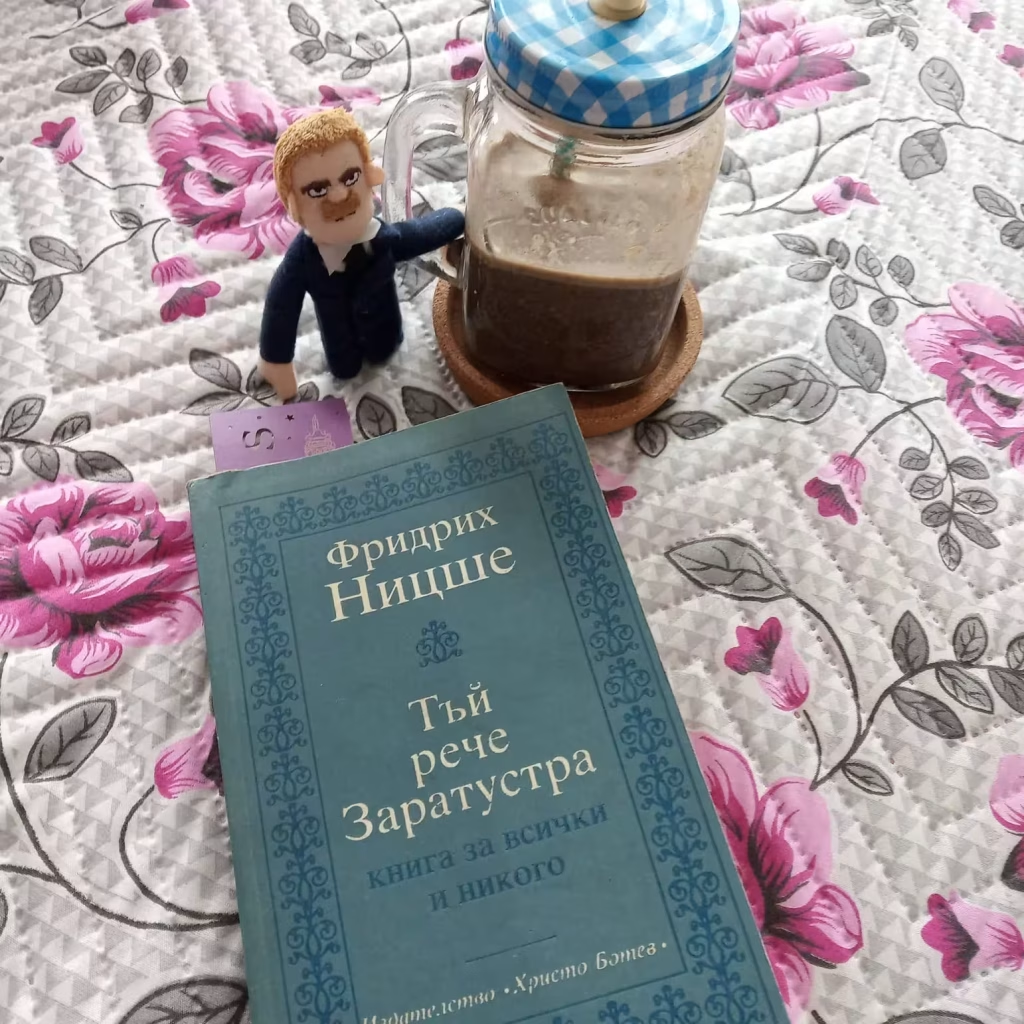
As his interests you can find: metaphysics, aesthetics, ethics, ontology, philosophy of history, psychology, theory of values. Comprehensive, right? I say this to draw your attention to the kind of topics he was interested in, the hard questions he asked himself, and how he racked his brains all his life to answer them. To help us at least in part understand life more deeply. He reflects on such themes in Thus Spoke Zarathustra.
The parables are short stories from the life of the prophet Zarathustra as he walks the earth, experiencing situations that make him think about life, its meaning, the afterlife, etc. and sharing it with us. My overall opinion of the book is that if one is interested in philosophy or just thinking about eternal topics and wants to learn another position, the position of a respected thinker - Thus Spoke Zarathustra is their read. With that in mind, however, many of the positions Nietzsche took through his character did not match mine. His views often struck me as outdated, slightly sexist and, frankly, from the position of a very distressed man. But that's not entirely a bad thing, because Nietzsche was a very suffering man, his life passed with many life crises, downfalls and ended with a serious illness. Which also tormented him while writing his final texts.
I think a work should always be viewed in the context of its author's time, and viewing Thus Spoke Zarathustra through that prism makes it a very advanced and valuable read. A reading about the meaning of life. Whatever position its author takes, one has to ask: how many such texts are there. Texts that help us to understand that we are not alone in asking these questions, that people far before us and perhaps long after us will think about them. They'll be banging their heads and probably won't be able to find an answer. That's the beauty in subtle irony about the meaning of life, and Nietzsche helps me enjoy it.

 English
  Bulgarian
  Spanish