"The monk who sold his Ferrari" by Robin Sharma

Book: "Three hundred thousand Sofia between the two wars and me"
Author.
Genre: Prose
Rating (1 to 6): 5
Sofia is so many things to so many people. It is opportunity, adventure, work, home. It is the capital of our small country and even though our national psychology says "Sofia is not Bulgaria", Sofians would often love to try and disprove that statement.
Sofia is history. For many of its citizens it is a refuge, almost like Braila for the Huns, it offers opportunities for work, for a home, for a social environment, which in our hectic everyday life and constantly changing economy are necessary for our survival. But Sofia is history first. And to truly love it for what it is, we must get to know it - as Grandfather Vazov advised us.
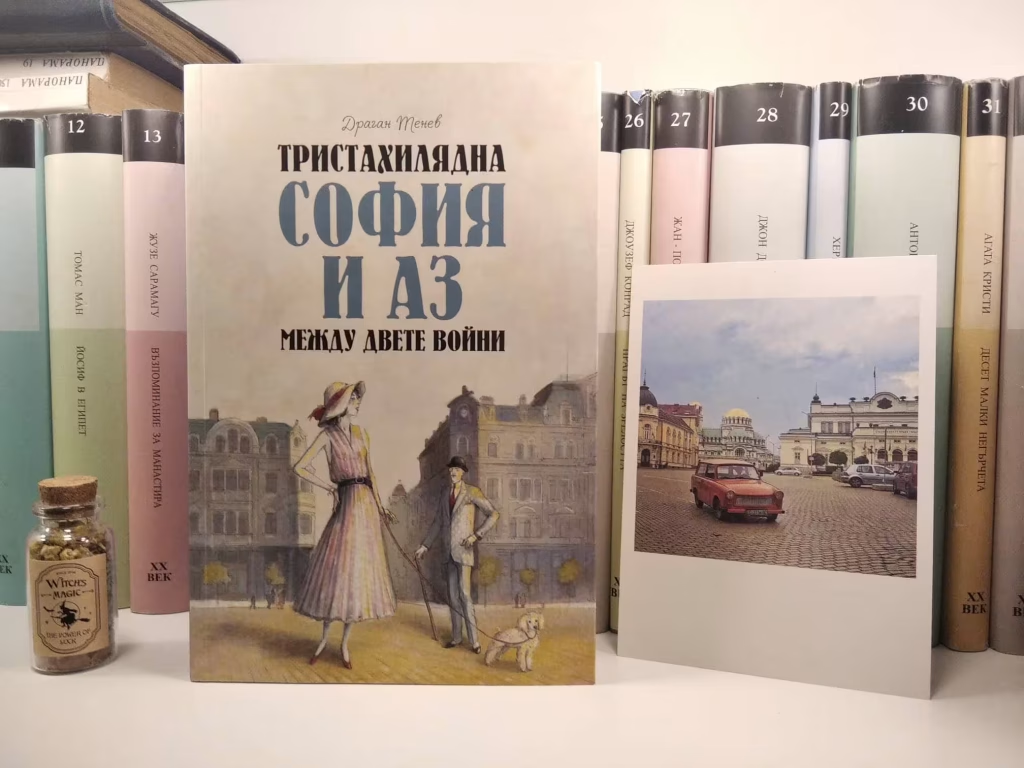
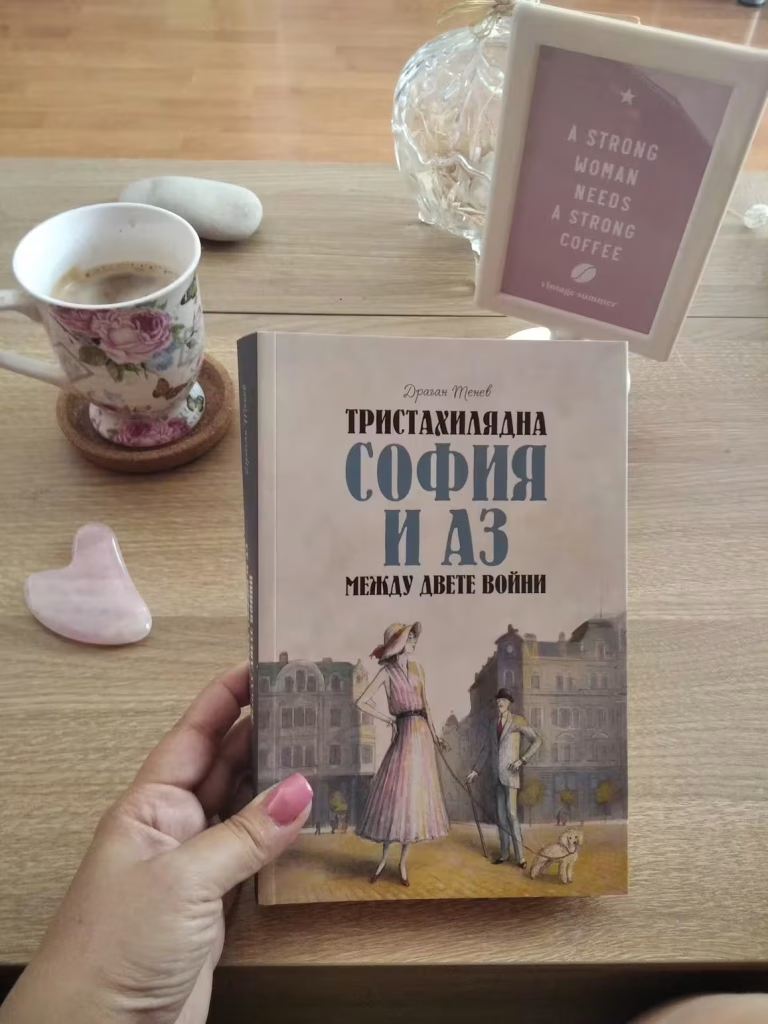
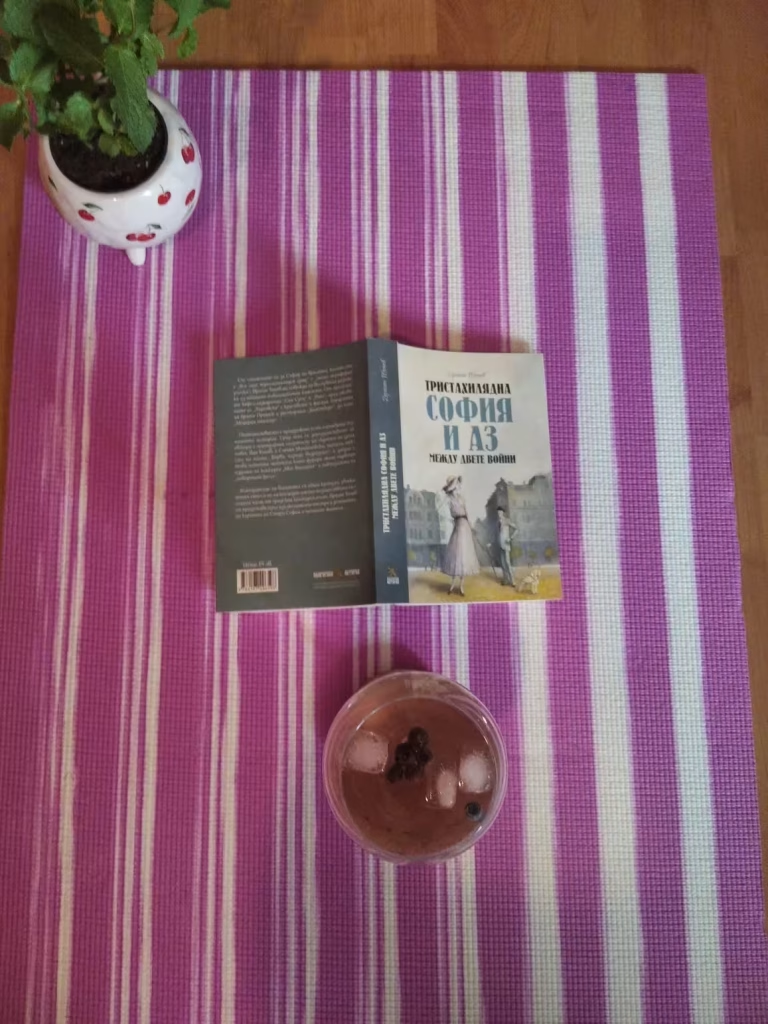
I'll start with the only thing I kind of didn't like. It is only that the cover misled me about the content of the book. I rarely reach for a title without having researched it at least a little, but this one won me over in a book lane with a title and cover. I said to myself: a romance novel set in 1930s Sofia - wonderful. I got something completely different. Something I really liked, but just wasn't expecting.
"Three Hundred Thousand Sofia Between the Two Wars and Me" offers a very valuable look at the history of the city, not just as statistics, but as personal history, as memories. Dragan Tenev was born in the not so recent 1919 in Sofia. In his book he tells us about his childhood on ul. "Shipka", about the development of the central part of the city. He also tells us about the cafes, Prošek's brasserie, the restaurants in which the intellectuals of Sofia of the XX century gathered.
It presents us with a Sofia reminiscent of Paris, Vienna, the European capitals of the time, which pulsate with the energy of writers, musicians, artists, and most of all the energy of the souls who survived the First World War, appreciating the beauty of the world around them.
Dragan Tenev uncovers interesting stories about the places we visit or watch in photos and films. Stories that we might not hear elsewhere because they have been told to him by people in his life who have experienced them or heard them from other people in their lives. These are the type of urban legends, however, that we hear from a form of primary source.
Each chapter is a separate short story of Dragan's childhood and life in Sofia. Within a page or two we get a piece of history. To illustrate the urban legends with an example, I will share with you one of the chapters that really impressed me:
When Sofia was still a city of three hundred thousand people, in the early 1930s, there were dozens of beer halls - favourite meeting places of the citizens of Sofia. They were especially popular in the summer, as most of these godly establishments had gardens and as early as May tables were set up there, covered with neatly clean tablecloths. Among the multitude of "family beer-houses" in the capital, as they were usually called in order to emphasize their "respectability" even more by their name, the "Proshek's Beer-house" ranked first. It was located at the corner of ul. "San Stefano" and Blvd. "Tsar Osvoboditel" and its vast "hall", as we would say today, was leaning against the fence of the beer factory, and the empty space in front of it was a spacious garden with beautiful lime trees. From the garden one could see unobstructed the beautiful Eagle Bridge, built by the citizens of Sofia in 1894 to welcome the last Bulgarian exiles from Diyarbakir.
I got to know the Proshek Brewery from my earliest childhood in the 1920s. In those days, grandpa and grandma would regularly drop by there on summer Sunday mornings to have a beer before our walk in the Borisov Garden, and during this "ritual" I would drink my "duty" lemonade from the bottle, corked with a glass ball that opened its "throat" only after the ball was pressed down.
On one of those Sunday visits to the garden of the "Proshek's brewery" Grandfather told a story that has remained in my memory for years to come with great clarity, because even then it made an extremely strong impression on me. Grandfather, a former member of the Second Bulgarian Volunteer Brigade, had fought in the battles of Stara Zagora and Shipka and had an endless supply of stories about those heroic days, but he had never told us the story of the brewery's owner, the Czech engineer Jiří Prošek, who was actually the owner of the brewery behind it. In fact, the story was worth it. It began with the birth of Jiří Prošek, who came into the white world in a village near Prague around the middle of the last century and, like most poor people in the wide world, went not only through the Technical Faculty in Prague but also, in parallel, through the great university of life. When he finished his studies, Prošek came to Bulgaria in 1869 and was appointed as an engineer for the construction of the Baron-Hirsch railway from Adrianople to Plovdiv, and later he even became the head of the fifth section on this line. His headquarters were in the village of Atmanliy, where the young Czech quickly got in touch with the local revolutionaries and, using his high official position, began immediately to supply Levski's friends with arms and ammunition. Prošek arranged a small school in Atmanli, established a children's choir, began to record Bulgarian folk songs and customs, and regularly sent dispatches to various Czech newspapers about the situation in our enslaved homeland. Later, he even met Levski, and during the April Uprising he secretly sent reports about the atrocities in Bulgaria around the suppression of this great popular uprising.
Engineer Proshek greeted the declaration of the Russo-Turkish War of Liberation with enthusiasm. During one of his official trips to Constantinople in August 1877, he accidentally learned that the Turkish General Command was preparing to send reinforcements for Suleiman Pasha, who was fighting to the death with the Russian troops and Bulgarian volunteers defending the Shipka Pass. The Czech, who clearly understood the importance of the outcome of the fighting in the Balkans for the future course of the war, immediately returned to Bulgaria and, taking all the risks on his own head, ordered the removal of about two hundred metres of railway line under his command, declaring that there was a fault in the track which exposed to death and destruction the trains which would pass through it. Thus, while the "fortification work" to restore the line lasted, Prošek delayed Turkish reinforcements for Suleiman Pasha for more than 24 hours. It was during these same hours that General Radetzky arrived at Shipka. Of course, Turkish military intelligence quickly discovered Prošek's sabotage, but disguised as a jester, the Czech managed to escape Atmanlius and cross the Danube. For this feat the engineer Prošek received from the Russian Emperor a special sabre and the Order of St. Alexander on the neck" - one of the greatest honors of Russia. Later, the Czech, who sincerely loved Bulgaria, joined the Russian army and fought in its ranks, and after the Liberation War he settled in Sofia permanently. He never returned to Bohemia, declaring Bulgaria his second homeland. At first, Jiří Prošek worked as an engineer on the construction of the Sofia - Varna line, and later, together with his brother, he opened the Prošek beer factory, famous among the citizens of Sofia, together with the brewery where I heard his story.
Somewhere around the mid-1930s, the Proshek's Brewery ceased to exist and was replaced by the two large co-operative buildings that still stand today, but no matter how many times I pass by San Stefano, I always remember with nostalgia that beautiful brewery with its garden and lime trees. That's where I used to drink the sweet, cheap lemonade as a kid and thought life was very, very nice...

 English
  Bulgarian
  Spanish